


Book reviews
“The Urge: Our History of Addiction” by Carl Erik Fisher
Posted on April 23, 2026, tagged as Addiction Recovery, Alcoholics Anonymous, Alcoholism, Book Review, Twelve Steps
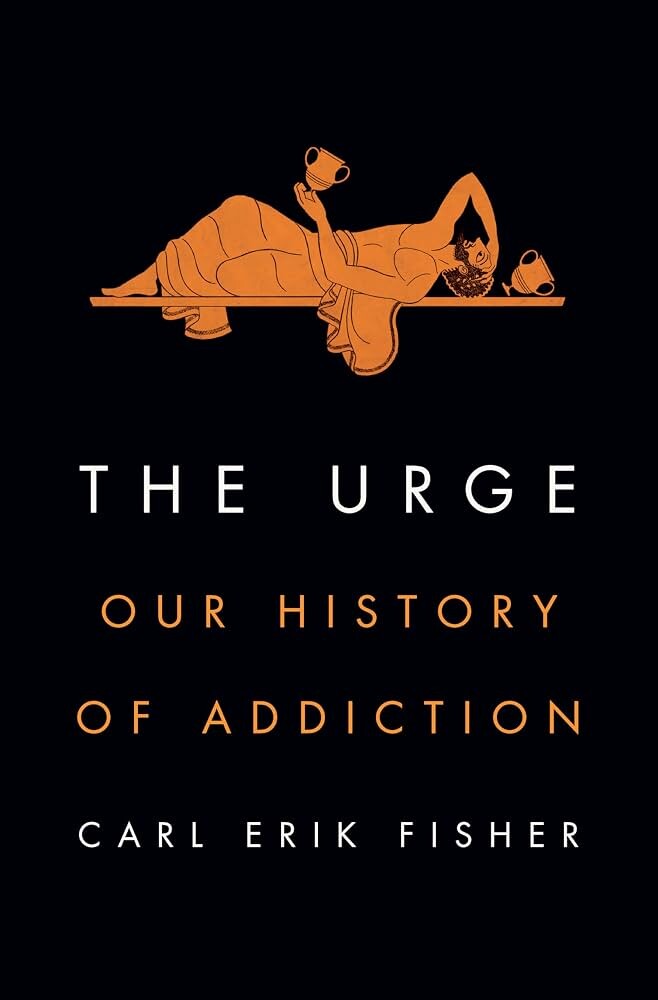
This book, copyright 2022, is an excellent source of information on the history of addiction, starting with the mention of a poem, the Gambler’s Lament, found in the Rig Veda, a collection of sacred Hindu writings composed between around 1500 and 1000 BCE. The book takes us through epidemics such as the Gin Craze in England starting around 1700, the heavy rum consumption during American Revolutionary times, and the opiate addiction epidemic currently underway. He talks about the battle between “wets and drys,” those who want to control the harms to people and to society by prohibition, or alternatively by correcting underlying social evils and offering treatment. He subjects the American experiment of Prohibition to considerable analysis. In the United States we have gone through other attempts at control, including scaring people with propaganda, such as with the movie Reefer Madness (1936) which misrepresented the harms that can befall someone who tries marijuana. He talks about the modern alcoholism movement which began with the formation of Alcoholics Anonymous in 1935, and the publication of the book by the same name in 1939. He gives a substantial amount of ink to Marty Mann, a woman who was a patient of psychiatrist Harry Tiebout.
Dr. Tiebout was connected to the founders of AA early on and gave Ms. Mann a prepublication copy of Alcoholics Anonymous in early 1939. She contacted the principal author, Bill Wilson, joined the group, and quit drinking. She went on to a career of lecturing, organizing, and moving the national attitude forward towards understanding alcoholism as a treatable disease. During the same period, there was great opposition to treatment and an ongoing “war on drugs.” A major case came up because of an arrest made in California in 1960, a time when being addicted to drugs itself was a crime punishable by a fine and imprisonment. This made it all the way to the U.S. Supreme Court, where the law was declared unconstitutional. In 1971, President Nixon declared a “War on Drugs,” and President Reagan redeclared a “War on Drugs” in 1982. Laws sent millions of people to prison for cocaine possession in the 1990s, and in the United States there are still an astonishing number of people in prison, proportionately higher than in other countries, and a high proportion of these for drug crimes. This battle continues to rage. He goes through a history of treatment in the United States, including the Minnesota Model popularized by the Hazelden foundation, the influence of “tough love” programs such as Synanon which offered harsh confrontation to break down the addict until they were amenable to redefining themselves, and the use of medications such as naltrexone, methadone and buprenorphine. He talks about Dr. Marie Nyswander and Vincent Dole who developed methadone as a treatment for heroin addiction in 1962. I was delighted to read the name of one of their principal collaborators, Dr. Mary Jeanne Kreek, whom I had the pleasure of hearing several times at meetings of what is now the American Society of Addiction Medicine (ASAM). (You may access a talk of hers on YouTube from 2016, where she talks about addiction and her ground-breaking research on brain chemistry in addiction. The talk is quite technical and presents a viewing difficulty, namely, that she references slides that she is showing to her audience, but which we don’t get to see on YouTube. If nothing else, the viewer can appreciate the level of scientific inquiry that has gone into addiction by serious researchers.)
Dr. Fisher spends much time on whether addiction is or is not a disease. I will write about this separately in my blog for this month. I am happy to have this book in my library, and I have recommended it to many people who call me with questions, people who I believe would benefit from some quality education about alcoholism and addiction for one reason or another. Dr. Fisher identifies as a recovering alcoholic and tells his own story of addiction and recovery as he writes. The personal story is both interesting and instructive for those who are seeking to understand addiction for their own self-understanding, or to grasp an understanding of what might be going on with a loved one.