


Book reviews
The Higher Power of the Twelve-Step Program for Believers and Non-Believers by Glenn F. Chesnut, Author’s Choice Press, 2001
Posted on August 21, 2026, tagged as
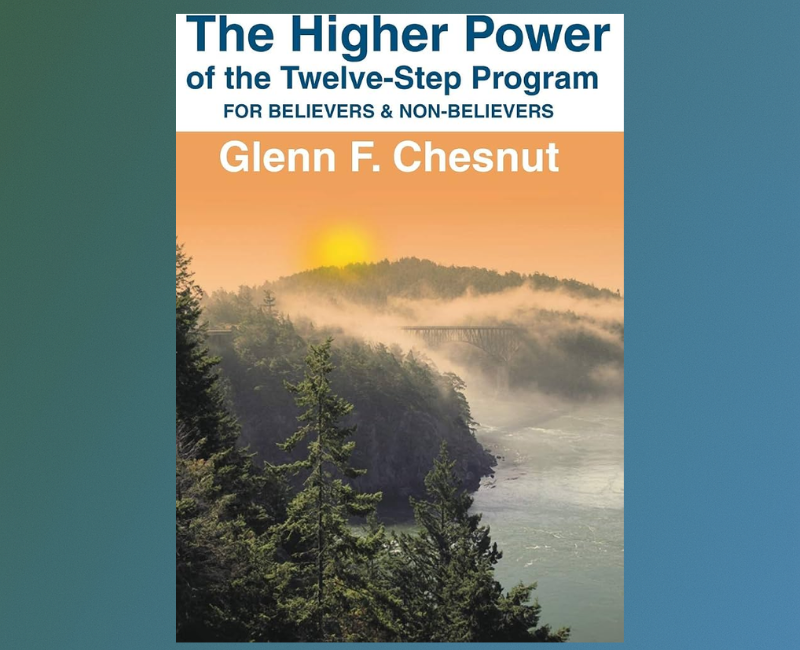
This is an excellent book that offers readers useful information about things to think about when approaching the idea of a higher power. Dr. Chesnut emphasizes that when considering this idea, people need to keep an open mind. He thinks that whatever childhood impression of God one brings to the program needs to be abandoned. He says, “My first observation is that no one—absolutely no one—learns to work the twelve-step program well, who has not cut the umbilical cord connecting them with their childhood religious beliefs.” He goes on to say, “You learn the A.A. spiritual program by going to A.A. meetings and actually doing what the people there tell you they do.” He says that for a while you will not understand how this will help you, but that you will “get A.A. spirituality at a deep level only by working through all the steps.”
Dr. Chesnut talks about the fact that only you can decide how to think about a higher power and what, if any, name you will call it by. As a historian he invokes many great thinkers as he educates the reader about how such people have talked about a higher power. These philosophers and theologians include Plato, Thomas Aquinas, C.S. Lewis, Socrates, St. Augustine, and Emmet Fox. Regarding Emmet Fox, he talks about the outsized influence he had on the earliest AA members. Fox used to talk about what he called The Golden Key that he said would work for anyone in any situation. He said, “Stop thinking about the difficulty, whatever it is, and think about God instead.” One would think that it can’t be that simple, but for those who are willing to try it, it has worked wonders in getting through resentments, fear, and tough times. Dr. Chesnut invokes the wisdom of multiple religious traditions including Judaism, Christianity, Islam, Buddhism, and Native American traditions.
He goes through what he calls the six beginner’s blocks that impede newcomers from grasping the higher power idea. These are believing they are too strong (powerful) and too smart; fear of being in God’s presence; intellectualization; blaming and hating God; feeling abandoned by God; and inability to commit to trying this way of living. These well describe the stage of the heroic journey in which the incipient hero refuses the call to adventure. He also describes eight types of spiritual awakenings.
He also delves into some AA literature, and gives the history of Richmond Walker, the man who wrote the book, Twenty-four Hours a Day. For many years this was the primary meditation book used by AA members. He also mentions Father John Doe, the first Roman Catholic priest member of Alcoholics Anonymous. I will mention two more things now. First is that Dr. Chesnut was a serious AA historian who has written a fascinating biography of Father Ed Dowling called Father Ed Dowling: Bill Wilson’s Sponsor. (I will review this book in a subsequent newsletter.) The other is that I had read both books quite some time ago and it is only today, when I sat down to write, that I noticed that his name is Chesnut, not Chestnut. This is a good lesson for me in being observant. For people struggling with the “God stuff,” this book will be a helpful guide to getting comfortable with this aspect of the AA program. I hope that you all find your way to a better place on your recovery journey